

Mission solution
Maritime domain awareness
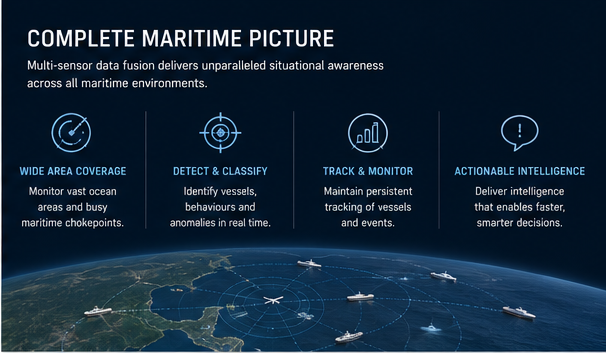
Multi-source maritime awareness for coastlines, EEZ context, vessel behaviour review and route verification.
Operating challenge
Practical buyer problem
Maritime teams often work with AIS, radar, patrol reports, vessel traffic systems and separate sensor feeds that do not always explain uncertainty clearly. The practical requirement is not more raw data; it is better correlation, operator review and evidence-ready context.
Sky Shadow mission architecture
Air, surface, subsea, fixed-site and software layers
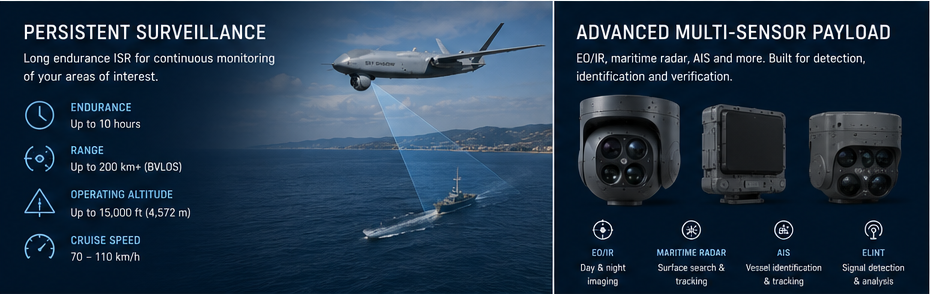
Sky Shadow may connect aerial ISR, surface systems, fixed coastal sensors, subsea infrastructure context and external maritime signals into a structured awareness workflow. ARGUS and SHADOWCORE support correlation; AEGIS keeps review and escalation human-commanded; Research preserves the resulting record.
Relevant platforms
Platform families that may fit this mission
Platform fit depends on the operating area, authority model, current systems, data handling requirements and evaluation objectives.
Sky Shadow ISR
View the public product briefing structure and controlled-disclosure overview.
Black Shadow
View the public product briefing structure and controlled-disclosure overview.
Sea Ghost B1
View the public product briefing structure and controlled-disclosure overview.
Star Shadow
View the public product briefing structure and controlled-disclosure overview.
Relevant technology layers
Software and command layers for reviewable awareness
SHADOWCORE
Prioritises relevant sensor events and supports anomaly review so operators can focus on the activity that needs attention.
ARGUS
Correlates platform, fixed-site and external signals into a clearer operating picture for review.
AEGIS
Routes operator tasking, review, escalation and coordination while keeping decisions human-commanded.
Research
Preserves event records, mission notes, evidence packs and briefing outputs for later review.
PHAROS
Supports persistent watch across defined zones, routes, asset perimeters and fixed-site operating areas.
Example pilot pathway
From assessment to scale decision
A pilot should be configured around a defined mission question, controlled evaluation and evidence-led review.
Assessment
Review mission context, geography, current systems, operating constraints and sensitivity level.
Configuration
Define the platform mix, software layers, evidence outputs, review workflow and success criteria.
Controlled pilot
Run the agreed pilot in a safe, lawful and operationally appropriate way.
Evaluation
Measure coverage quality, event relevance, operator workload, evidence usefulness and integration fit.
Scale decision
Recommend phased deployment, further testing or a no-scale decision where justified by the evidence.
Evidence outputs
Outputs that support review and decision-making
Event timeline
A structured record of notable activity, review points and escalation moments.
Operator review notes
Human review context, assumptions, uncertainty and decision rationale where appropriate.
Evidence pack
Relevant event material grouped for operational review, reporting or briefing use.
Mission summary report
A concise review of mission context, observed activity, limitations and outcomes.
Integration recommendations
Practical next steps for data handling, workflows, systems and scale decisions.
Controlled briefing route
Request a private mission briefing
Share the mission context, organisation type, operating geography, current systems, timescale and sensitivity level so Sky Shadow can assess whether a private briefing or pilot discussion is appropriate.
Holo-Fusion Operational View
Coastal and EEZ awareness as a shared mission view.
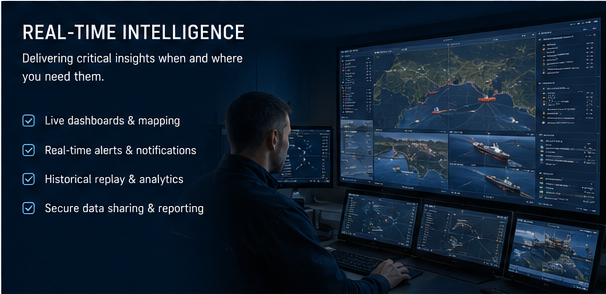
For maritime domain awareness, Holo-Fusion can connect coastal sites, wide-area routes, vessel context, air observation, alerts, replay and evidence-ready reporting into a single reviewable operating picture.
Depending on the deployment, customers can use software-only views, compact Fusion Panels, Holo Panels or the flagship Holo-Fusion Command Table.
Platform state, connectivity, sensor health and mission status.
Operator-reviewed tracks, watch zones, protected areas and alert context.
Review timelines, operator notes, evidence records and briefing outputs.