

Persistent Monitoring for Ports and Offshore Assets
Intro
Ports, offshore platforms, coastal terminals, anchorages, and vessel approaches represent some of the most surveillance-intensive environments in contemporary maritime operations. These zones demand persistent monitoring, anomaly detection, rapid cueing, and decision-quality intelligence across long time horizons and often under changing weather, lighting, and traffic conditions. Traditional patrol assets remain valuable, but they are expensive to sustain continuously and can leave surveillance gaps between sorties, patrol windows, or operator availability.
Persistent monitoring systems change that model. A well-designed autonomous platform can extend sensing reach, increase revisit frequency, reduce operator burden, and create a more continuous operational picture across maritime infrastructure and vessel movement corridors. For port operators, coast-guard functions, offshore asset owners, naval users, and strategic logistics stakeholders, the advantage is not simply more imagery. It is more structured awareness, faster detection, and a more actionable understanding of what is normal, what is changing, and what requires intervention.
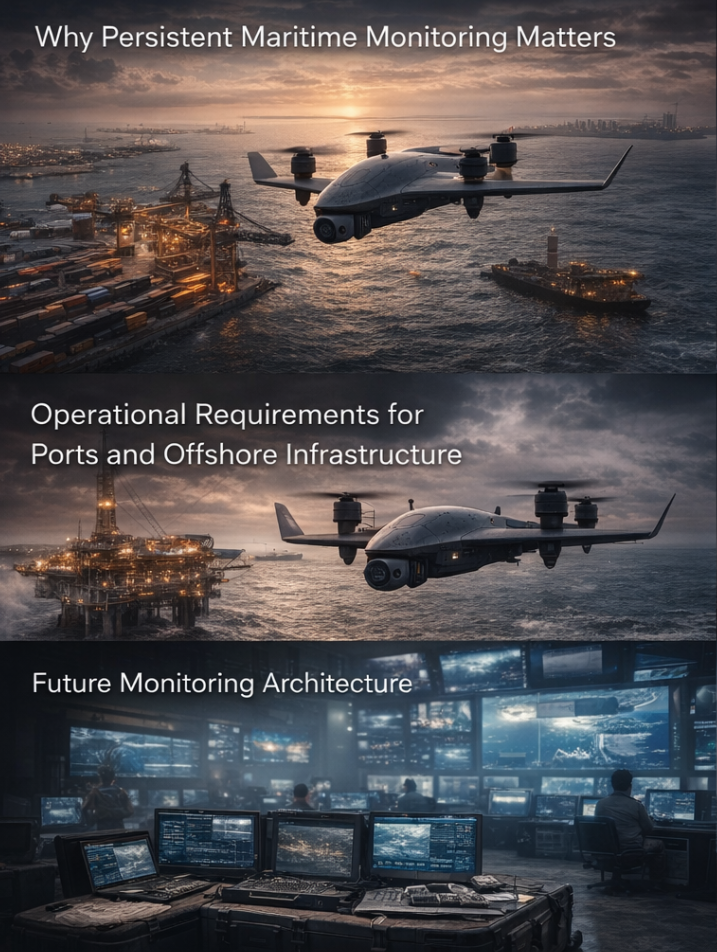
Why persistent maritime monitoring matters
Ports and offshore assets are exposed to a broad spectrum of operational risks: unauthorised vessel approach, perimeter breaches, loitering activity, logistics disruption, environmental incidents, infrastructure interference, and low-visibility maritime movement. These risks are not evenly distributed, and they do not always occur during staffed observation windows. Persistent surveillance therefore becomes a force-multiplying capability. It allows operators to observe patterns over time, identify anomalies against baseline behaviour, and maintain awareness over dispersed or difficult-to-access maritime zones.
In practical terms, persistence supports three high-value outcomes. First, it compresses the time between an event emerging and an operator becoming aware of it. Second, it improves evidence quality by generating a more continuous intelligence record instead of isolated snapshots. Third, it reduces dependence on costly manned coverage for routine monitoring tasks, allowing human operators to focus on escalation, interpretation, and response.
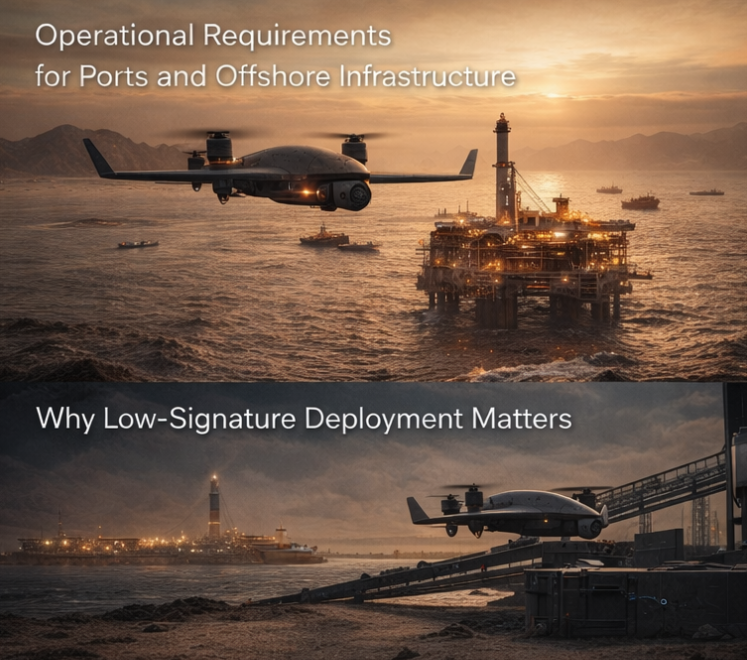
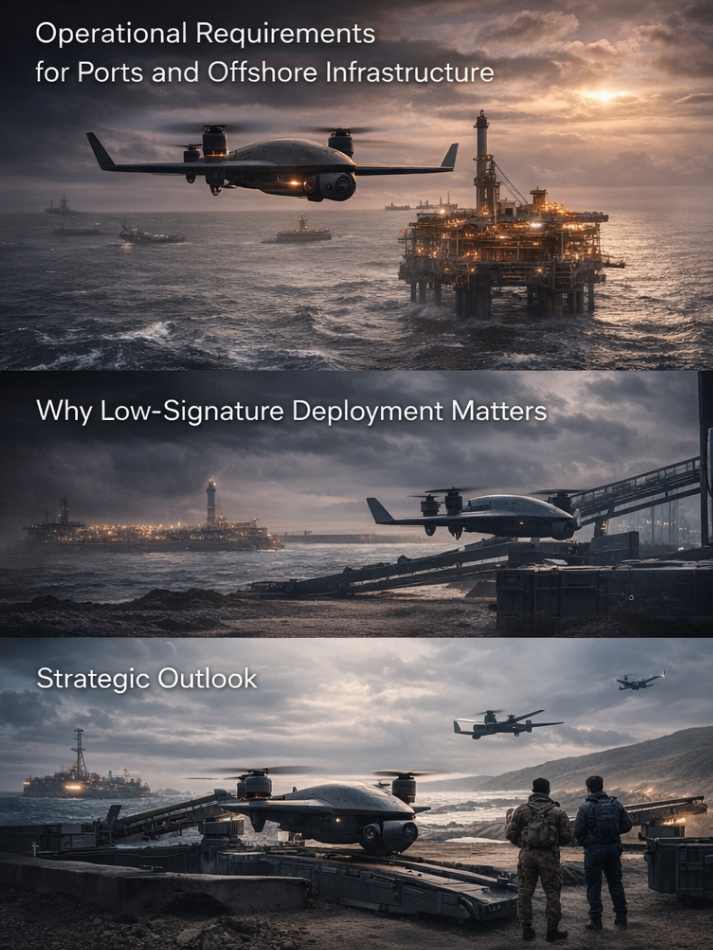
Operational requirements for ports and offshore infrastructure
A credible monitoring architecture for port and offshore environments must do more than remain airborne. It must generate useful ISR output under realistic mission constraints. That means endurance, sensor quality, low-signature deployment logic, resilient communications, reliable launch and recovery cycles, and the ability to integrate into broader command-and-control or site-security workflows. The surveillance requirement also changes by environment. A container port may prioritise berth monitoring, perimeter awareness, vessel sequencing, and critical choke-point observation. An offshore platform or energy installation may prioritise exclusion-zone monitoring, approach detection, over-water perimeter coverage, and rapid visual verification of suspicious activity. A coastal terminal may require a blend of shoreline observation, harbour traffic awareness, logistics security, and after-hours monitoring. The common requirement across all of these is not a generic drone. It is a mission-adaptable system that can support persistent awareness as part of a larger operational architecture.
Persistent monitoring is valuable only when it produces usable intelligence, shortens detection timelines, and improves decision-making across maritime infrastructure and vessel-approach environments.
Persistent monitoring for ports and offshore assets is no longer a niche capability. It is becoming a baseline requirement for organisations that need resilient maritime awareness across large, dynamic, and security-sensitive operational zones. The systems that will define this category are those that combine persistent collection, mission adaptability, low-signature deployment, and usable intelligence output rather than simply offering airborne presence.
For ports, offshore platforms, coastal terminals, and strategic maritime users, the operational value lies in earlier detection, stronger verification, more continuous observation, and a better basis for intervention before disruption, intrusion, or escalation occurs. The future belongs to surveillance architectures that integrate autonomous platforms with wider sensing, command, and security workflows.
Sky Shadow is being developed with that requirement in mind: not as a generic drone proposition, but as a mission-relevant surveillance system concept built around endurance, discretion, modularity, and operational utility in demanding real-world environments.
The role of autonomous systems
Autonomous systems become strategically valuable when they reduce workload while increasing awareness. In maritime monitoring, this means supporting repeatable surveillance patterns, predictable revisit cycles, route discipline, and efficient coverage of predefined areas of interest without requiring continuous manual piloting. The objective is not autonomy for its own sake. The objective is sustained, reliable sensing and more efficient operator attention. A well-configured autonomous monitoring platform should be able to support scheduled patrol logic, contingency rerouting, sensor-tasking adaptability, and the rapid hand-off of intelligence outputs into downstream workflows. That may include port-security teams, offshore control rooms, maritime operations centres, infrastructure security managers, or future integration with broader ISR stacks. In this model, the platform is not just an aircraft. It is a sensing node within a surveillance system.
1. Why low-signature deployment matters
In many security-sensitive environments, persistence alone is insufficient if the platform creates unnecessary visibility, acoustic signature, or operational predictability. Low-signature deployment philosophy matters because it can preserve discretion, reduce the probability of avoidance behaviour by observed actors, and limit operational exposure in environments where surveillance itself may be contested, monitored, or deliberately tested. For ports and offshore assets, this matters in both routine and elevated conditions. During routine operations, discretion supports more natural behavioural baselining and less intrusive monitoring. During elevated conditions, it can improve the utility of directed surveillance, perimeter verification, and rapid-response reconnaissance. Low-signature logic should therefore be treated as part of the mission system concept rather than a cosmetic design preference.
2. Future monitoring architecture
The future of port and offshore surveillance is likely to be layered, autonomous, and integration-driven. Persistent monitoring platforms will increasingly sit alongside fixed sensors, radar, access-control systems, AIS feeds, site cameras, and human patrol elements as part of a fused awareness picture. The most valuable systems will not be the ones that merely stay in the air the longest. They will be the ones that deliver the clearest, most actionable intelligence per deployment cycle and integrate cleanly into wider operational workflows. Sky Shadow’s relevance in this space is grounded in that systems-level view. The aim is to support persistent maritime awareness through platforms and mission concepts designed around endurance, discretion, modularity, and operational utility. For infrastructure operators and strategic maritime users, the value lies in earlier detection, better verification, more continuous observation, and a stronger basis for operational decision-making.
Strategic Outlook
The long-term direction of maritime surveillance is toward layered, autonomous, and integration-driven operating models. Ports, offshore installations, coastal terminals, and fleet operators increasingly require surveillance systems that can maintain persistent coverage, support anomaly detection, and feed decision-quality intelligence into wider operational workflows without imposing unsustainable manpower or patrol burdens. In that environment, the most effective platforms will not be those defined only by isolated flight metrics. They will be the systems that combine endurance, sensor relevance, communications resilience, modular payload architecture, and low-signature operational logic into a coherent ISR capability. The challenge is not merely to observe more. It is to observe better, classify faster, and support intervention with greater confidence. That is the context in which Sky Shadow is being developed. The objective is to contribute to a surveillance architecture capable of supporting persistent maritime awareness, stronger infrastructure monitoring, and more adaptable autonomous reconnaissance across complex real-world operational theatres.
Conclusion
Persistent monitoring for ports and offshore assets is no longer a niche capability. It is becoming a core requirement for organisations that need resilient maritime awareness across large, dynamic, or security-sensitive operational zones. The systems that will define this category are those that combine persistent collection, mission adaptability, low-signature deployment, and usable intelligence output. That is the standard Sky Shadow is being built to pursue.
Eu lobortis elementum nibh tellus molestie nunc non blandit massa. Diam phasellus vestibulum lorem sed risus ultricies tristique nulla. Nec tincidunt praesent semper feugiat nibh sed pulvinar proin ad gravida. Netus et malesuada fames ac turpis egestas maecenas pharetra convallis. Sed lectus vestibulum mattis ullamcorper velit sed ullamcorper morbi.